Applies to JCself, Gipfel version · As of 8 October 2026
JCself speaks German. Its window, buttons and messages are in German. This manual names every control exactly as it appears on screen, followed by an English translation in grey, for example Erzeugen (generate). The menu Optionen › Sprachen switches only older parts of the program to English, so we recommend leaving it on German.
Guiding idea
Melodies seek their way.
In JCself a melody is not fixed in advance. Notes arise one after another and influence which notes become more likely later on. In this way musical lines can form, change and disappear again.
So the composer does not prescribe every note, but sets the conditions under which the music develops: the range, the note lengths, how much chance is involved, the sound. The same settings produce a different piece every time.
This manual begins with a first piece to try out. After that come the installation, a tour of the window and an explanation of how JCself composes. The rest is for reference: it lists every setting together with what it does musically.
A first piece
Try JCself out first – the explanations come afterwards. If JCself is not set up yet, read the section Installation first.
- Start JCself. At the top of the window is the display, still empty. Below it are two tabs: Komposition (composition) for what is created, and Klang (sound) for how it sounds.
- In the tab “Komposition”, enter: Durchläufe (runs) 60, Tiefste Frequenz (lowest frequency) 110, Höchste Frequenz (highest frequency) 880, Kürzeste Dauer (shortest duration) 0.5, Längste Dauer (longest duration) 2. Tick Tonsystem verwenden (use tuning system) and Akkord · synergetisch (synergetic chord), and set the Lautstärke (loudness) from p to ff. Write decimals with a point: 0.5, not 0,5. A value takes effect as soon as you press Enter.
- In the tab “Klang”, choose the card MIDI · Instrumente. It plays without any other program. If Csound is installed, you can take the card Csound and the sound “Klavier” (piano) instead.
- Click Erzeugen (generate). The first time, JCself asks for a name for the piece, for example
First-piece.csd. Now you can watch at the top how JCself chooses note after note: where notes are chosen often, an area grows. At the end, confirm the message “Csound-Datei gespeichert” (Csound file saved) with OK. - Click Anhören (listen). Abbruch (cancel) stops.
- If you like the piece, save it: with MIDI via MIDI speichern (save MIDI) – the file is then placed next to the Csound file – and with Csound via WAV speichern (save WAV).

Click “Erzeugen” once more: the same settings produce a new, different piece. Then change a single value, for example the Auswahlmenge (selection size) to 3 – the music then circles around a few notes – or to 40 – it becomes more varied. This is the quickest way to get to know JCself.
JCself writes every new piece into the same file and asks “Diese Datei ersetzen?” (replace this file?) beforehand. If you want to keep a piece, choose Csound-Datei wählen … (choose Csound file) in the menu “Datei” (file) before the next “Erzeugen” and enter a new name; the old piece is then kept. You save your settings as a template.
Installation
JCself is a Java program. The same program package runs on Windows and on the Mac. JCself has not yet been tested on the Mac; the steps for it have been carefully prepared but not yet tried out.
What you need
- Java
- Java 8 or newer, free of charge. A current long-term support version (LTS) is recommended, for example Eclipse Temurin (the “JRE” is enough). Whether Java is already installed is shown by the command
java -versionin the Command Prompt (Windows) or in Terminal (Mac). - Csound (recommended)
- The free sound synthesis program from csound.com. With it you hear the exact pitches and the sounds built specially for JCself, and you can save WAV files. JCself has been tested with Csound 6.18. Without Csound, MIDI, the own WAV sound and SWAM/VSCO still work; JCself writes Csound files all the same.
- SWAM or sforzando (only if needed)
- External instruments that JCself controls via MIDI, plus a virtual MIDI connection: loopMIDI on Windows, the IAC driver on the Mac. See SWAM / VSCO.
The program package jcself-gipfel-en.zip from the download page contains the folder JCself with the program jcself-gipfel.jar, a start file for Windows (JCself-start.bat), one for the Mac (JCself-start.command), this manual as a PDF and a file README.txt.
Windows
- Install Java if it is missing.
- Unzip
jcself-gipfel-en.zip(right-click › “Extract All …”). Put the folderJCselfsomewhere you are allowed to write, for example in “Documents” or atC:\JCself. Not in “C:\Program Files”. - Start JCself by double-clicking
JCself-start.bat. If Windows shows a security warning the first time, confirm with “Run”; at “Windows protected your PC”, click “More info” and “Run anyway”. A small black window shows messages from Java; leave it open while JCself is running. - For Csound: install the “64bit Full Installer” from csound.com. JCself finds Csound in the Program Files folder by itself. Otherwise choose it once in the tab “Klang” under “Csound” with “Csound auswählen …” (choose Csound): the file
csound.exein the subfolderbin.
A shortcut on the desktop: right-click JCself-start.bat › “Send to” › “Desktop (create shortcut)”.
Mac
JCself has not yet been tried out on the Mac. We are grateful for feedback (contact).
- Install Java, for example Eclipse Temurin as a
.pkg: for Macs with Apple silicon the “aarch64” version, for Intel Macs “x64”. - Unzip
jcself-gipfel-en.zipwith a double-click and put the folderJCselfin “Documents”, for example. - Start JCself by double-clicking
JCself-start.command. A Terminal window opens; leave it open while JCself is running. The first time, macOS usually stops the file because it comes from the internet. Then right-click the file › “Open”. If macOS does not offer this, open “System Settings” › “Privacy & Security” and click “Open Anyway” there. - For Csound: install the macOS package from csound.com, or with Homebrew
brew install csound. JCself looks for Csound in/usr/local/binand/opt/homebrew/bin, among other places. If it does not find Csound, choose the filecsoundunder “Csound auswählen …”; in the file dialog, ⇧⌘G opens a field where you can type the path, such as/usr/local/bin/csound.
You can also start without the start file, in Terminal:
cd ~/Documents/JCself
java -Xmx600M -jar jcself-gipfel.jar
Particularities on the Mac: the menu bar is inside the program window, not at the top of the screen. The sound quality “Hoch · Rubber Band” for the own WAV sound exists only on Windows; on the Mac JCself automatically uses “Einfach” (simple). For SWAM and VSCO the IAC driver serves as the MIDI connection (program “Audio MIDI Setup” › “Window” › “Show MIDI Studio” › “IAC Driver” › “Device is online”). ⌘Q asks for confirmation like “Datei › Beenden” (file › quit) and saves the settings.
The working folder “Gipfel-Daten”
On the first start, JCself creates the folder Gipfel-Daten next to jcself-gipfel.jar. It holds all settings, the logs and temporary working files. If the program folder is not writable, JCself uses %LOCALAPPDATA%\JcSelf-Gipfel (Windows) or the folder JcSelf-Gipfel in your home folder (Mac) instead. Your pieces, on the other hand, you save wherever you like.
- New version
- Close JCself, copy the new
jcself-gipfel.jarover the old one, start again. The folderGipfel-Datenand all settings are kept. - Removing
- Delete the folder
JCself. JCself writes nothing into the system settings. - Older JCself
- The Gipfel version is independent of earlier versions (folder
PHS, start filejcself.bat); both can exist side by side. If an oldjcself.savis in the program folder, JCself takes over its settings on the first start.
The window
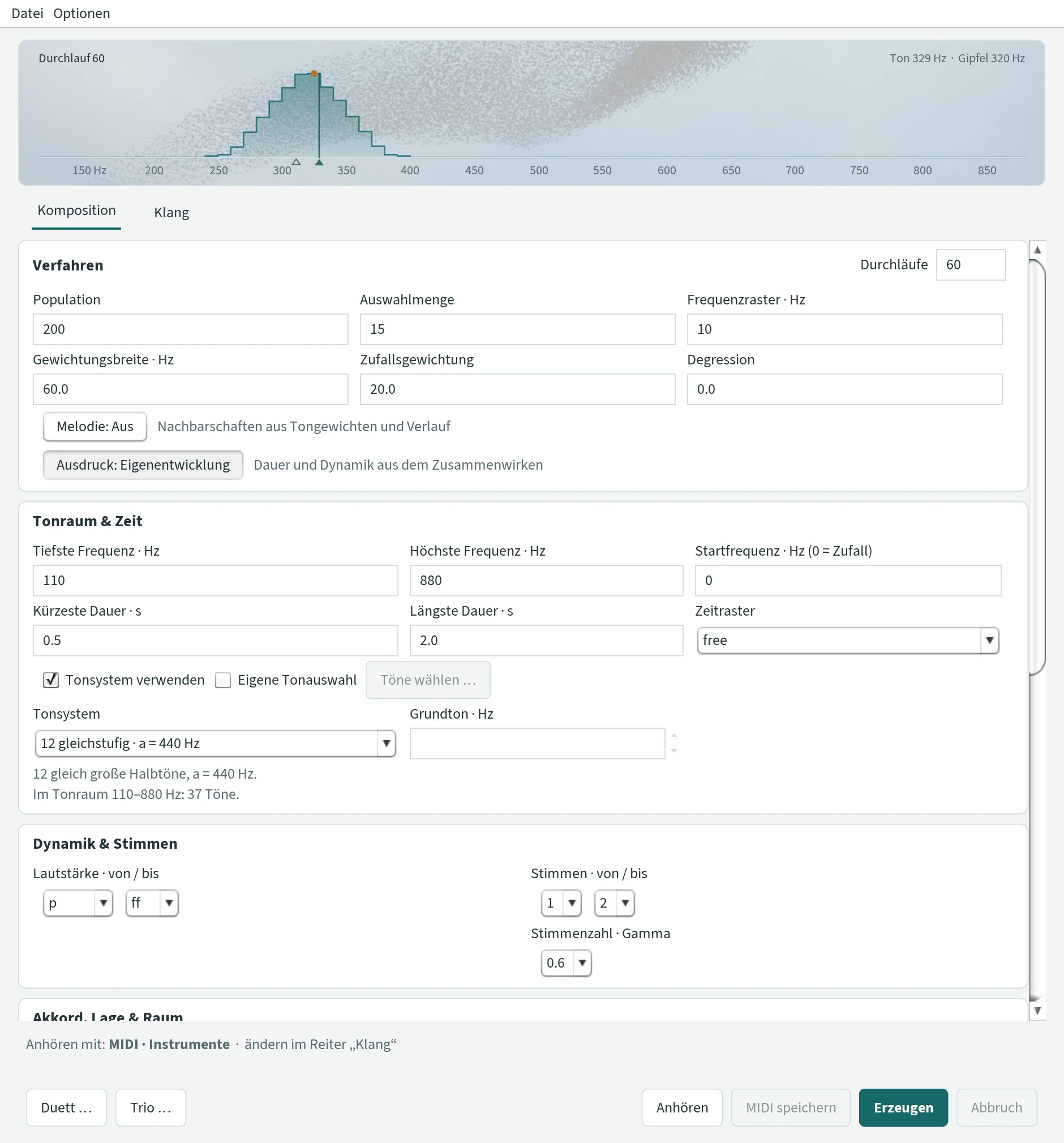
From top to bottom, the window has four parts:
- Menu bar
- “Datei” (file) and “Optionen” (options), see Menus and templates.
- Display
- Shows which notes JCself has chosen often. It grows while generating and runs along while listening, see The display.
- Tabs
- Komposition (composition): what is created – range, note lengths, loudness, voices, chords and more. Klang (sound): how it sounds – with MIDI, Csound, a recording of your own or external instruments. Both tabs can be scrolled down.
- Bar at the bottom
- The line “Anhören mit …” (listen with) says what you are currently listening with; clicking it opens the tab “Klang”. Below it are the latest message, on the left the buttons Duett … and Trio …, on the right Anhören (listen), MIDI speichern or WAV speichern (save), Erzeugen (generate) and Abbruch (cancel).

What applies everywhere
- Input: a value takes effect after Enter or when you leave the field. JCself does not accept invalid input; the field then shows the old value again. Write whole numbers without point or comma, decimals with a point.
- Tooltips: if you rest the mouse briefly on a control, an explanation appears (in German).
- While JCself is working (generating, listening, saving) all settings are locked; only “Abbruch” is available.
- Generate or just listen? Changes in the tab “Komposition” take effect at the next “Erzeugen”. Changes in the tab “Klang” already take effect at the next “Anhören” – the same notes then sound different. Exceptions are listed under Listening and saving.
- Settings are kept, even across a restart, see Settings and files.
How JCself composes
In short: JCself remembers which notes it has already chosen. What has been chosen often becomes more likely. In this way centres of gravity form that nobody determined – and they can shift again. If you know the following terms, you understand almost every setting.
The weight distribution
Imagine the range – from the lowest to the highest frequency – as a row of narrow compartments. How wide a compartment is, is set by the Frequenzraster (frequency grid). Each compartment collects weight: when a note is chosen from it, the compartment becomes heavier, and the neighbouring compartments get a share (Gewichtungsbreite (weighting width)). The heavier a compartment, the more likely it is to be chosen again. This weight distribution is empty at the beginning; it only arises while composing. The display at the top of the window shows it as an area.
A run
JCself composes in runs (Durchläufe). Each run yields a new note of the main voice (Hauptstimme):
- JCself draws a number of random candidate notes – as many as the Population says.
- It rates each candidate by the weight of its compartment, with a little chance added (Zufallsgewichtung (random weighting)).
- From the best candidates – as many as the Auswahlmenge (selection size) specifies – it picks one at random. This is the new note.
- The note makes its compartment heavier.
- Weight and position of the note give its duration, loudness, place in the stereo image and number of voices. Further voices, chord notes and a melody voice can be added.
Before the first run, JCself places a first weight on the Startfrequenz (start frequency). It gives the development a beginning but does not sound itself.
The peak
The heaviest compartment is called the Gipfel (peak); in the display it is the ochre dot. The peak moves when other compartments become heavier. When the main voice reaches a peak for the first time, JCself can react – with a sequence of notes, a repetition or a transposition (reaction at the peak) – and the additional melody voice changes its note. A peak already reached does not trigger again; new peaks become rarer as the piece goes on.
From weight to note
| Property | Where it comes from |
|---|---|
| Pitch | from the weight distribution, as described above |
| Duration and loudness | with “Ausdruck: Eigenentwicklung” (expression: self-development) from how much neighbouring notes support each other and how tired a region already is; with “Ausdruck: Direkt” from the weight: chosen often = short and loud, chosen rarely = long and quiet. Always within your limits. |
| Place in the stereo image | from the distance to the peak: above it on the right, below it on the left, at the peak in the centre |
| Number of voices | from the distance to the peak, within “Stimmen · von / bis” (voices from / to) |
| Chord notes | from a tension of their own: loudness, height of the note compared with the notes shortly before, a new peak |
| Sounding duration with “Pedal” | from the shadow sequence (see below) |
The shadow sequence
Alongside the audible sequence of notes, JCself always calculates a second, silent sequence with the same settings. Because chance is involved, it runs differently. It determines how long a note sounds with “Pedal” and when the tempo changes with the “Laufender Tempoverlauf” (running tempo curve). A shadow sequence of its own steers the additional melody voice.
Where the guiding idea lives in the program
- In the weight distribution: what sounds becomes more likely. Other regions can grow and take over.
- In “Melodie: Ein” (melody on): neighbouring notes that have already sounded make small steps more likely. If this support is missing, the bond loosens again.
- In “Ausdruck: Eigenentwicklung”: how long and how loud a note sounds depends on how much its neighbours carry it and how tired its region already is.
- In the synergetic chord: possible chord notes support and displace each other until some prevail.
- In duet and trio: several sequences of notes develop side by side and stimulate each other.
JCself does not recognise melodies, nor does it pick the most beautiful one. What we hear as a line only arises from the sequence of notes.
Three terms that are easily confused
- Main voice (Hauptstimme)
- The note that each run chooses. Only it changes the weight distribution. MIDI channel 1.
- “Melodie: Ein” (melody on)
- A switch for the main voice: it favours small steps to neighbouring notes that have already sounded.
- Additional melody voice (Zusätzliche Melodiestimme)
- A voice of its own high above the composition (c''–b''), which changes its note at new peaks. MIDI channel 8.
Tab “Komposition”
Here you decide what is created. The tab has six sections. A change takes effect at the next “Erzeugen” unless stated otherwise. “Default” is the value JCself starts with on its very first start.
Verfahren (method)
These values determine how JCself chooses its notes: how much chance is involved and how strongly what has been chosen prevails.
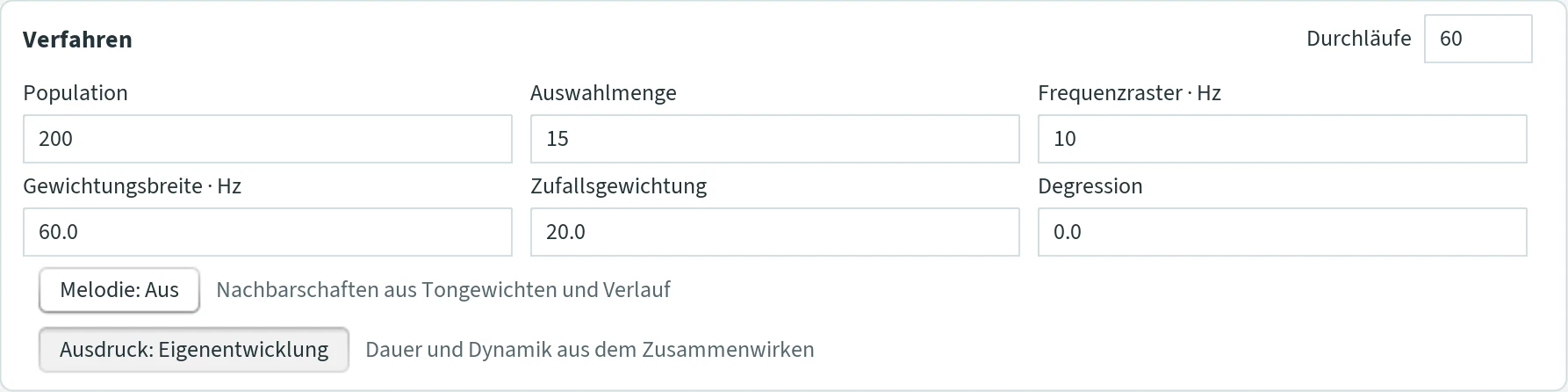
- Durchläufe (runs)
- How long the piece becomes: the number of notes of the main voice. In total more notes can sound (further voices, chords, melody voice) or fewer (rests). The display counts along. Default 50.
- Population
- How many notes JCself looks at to choose from in each step. Many: there is almost always a frequently chosen note among them – the music stays with its centres of gravity. Few: more chance. Default 200.
- Auswahlmenge (selection size)
- From how many of the best notes JCself takes one at random. Small (1 to 3): almost always the strongest region – the music quickly circles around a few notes. Large: more variety. The selection size cannot be larger than the population. It also determines how often the tempo changes with the tempo curve. Default 15.
- Frequenzraster · Hz (frequency grid)
- How finely JCself distinguishes pitches when it counts what has been chosen often – the width of the “compartments”. Coarse (about 50 Hz): nearby notes count together, centres of gravity become broad. Fine (about 5 Hz): every pitch counts on its own. The pitches themselves are not rounded. Default 50.
- Gewichtungsbreite · Hz (weighting width)
- How far a chosen note pulls its neighbours along, measured to each side. Wide: whole regions of notes become more likely together. Narrow: only the note itself. The neighbours are only reached when the value is at least twice the frequency grid. Default 250.
- Zufallsgewichtung (random weighting)
- How much chance plays a part in the choice. More: more surprise. Less: JCself follows more faithfully what has already been chosen often. Good to know: at the start and when a template is loaded, the same value also sets how much weight a chosen note receives; the two are then equal. A change during work therefore acts as “more” or “less” chance only until the next restart. Decimal greater than 0. Default 20.
- Degression
- Whether frequently chosen notes become ever stronger or wear out. 0: every choice counts the same. Positive: what is chosen often becomes ever stronger – the music freezes. Negative: frequently chosen notes gradually lose strength and recover later; the tonal centre wanders. Decimal, also negative. Default 0.
- Melodie: Aus / Ein (melody off / on)
- Favours small steps in the main voice – but only where neighbouring notes have already sounded. More precisely: if at least two different neighbouring notes (up to a major second) have carried a region, small steps there become more likely for a while. If this support is missing, the bond loosens. Note repetitions do not count, leaps remain possible. With other tuning systems, a small step is the largest step between neighbouring notes, at least a major second. Applies to all pieces and is not stored in templates. Default Aus (off).
- Ausdruck: Eigenentwicklung / Direkt (expression: self-development / direct)
- Where duration and loudness come from. Eigenentwicklung: every region of notes has a liveliness that grows and tires. Neighbours up to a major second support each other, distant regions slow each other down; sounding makes tired, rest restores. This gives how long a note sounds and how loudly it enters – always within your limits for duration and loudness. All voices of one entry get the same duration and loudness. Direkt: a frequently chosen note sounds short and loud, a rarely chosen one long and quiet; the loudness jumps in steps. Applies to all pieces, also in the duet. Default Eigenentwicklung.
Tonraum & Zeit (range & time)
Which notes may occur and how long they are.
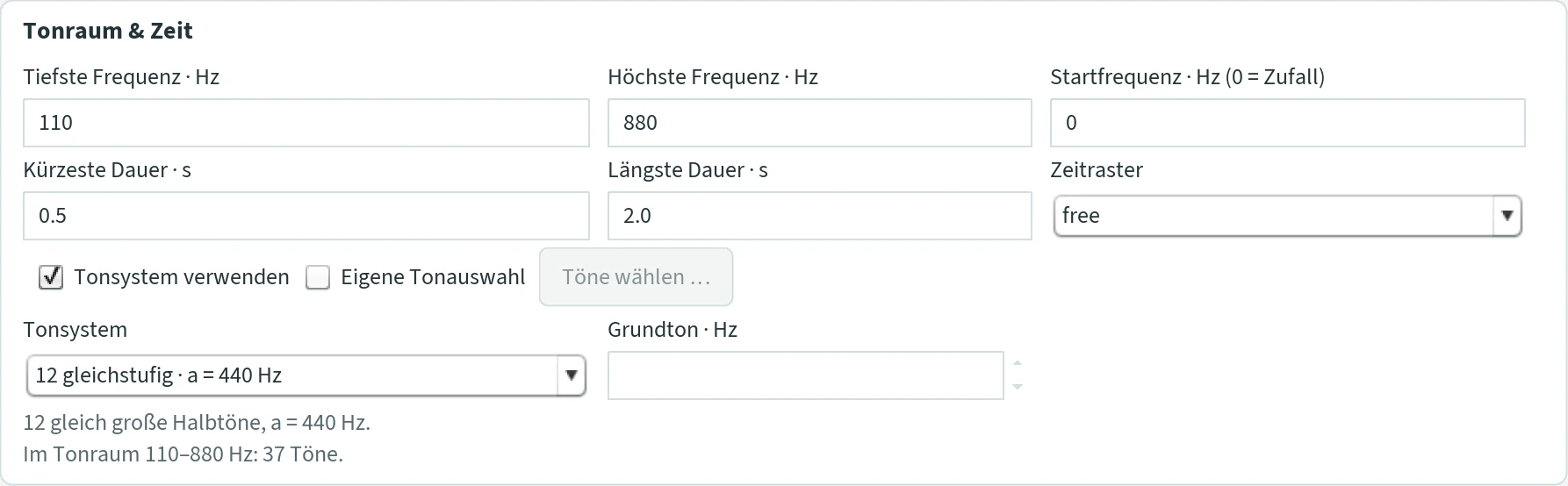
- Tiefste / Höchste Frequenz · Hz (lowest / highest frequency)
- The range in whole hertz (a' = 440 Hz). The main voice and the further voices lie within it. Chord notes may leave it; the additional melody voice always lies between c'' and b''. Default 20 and 20 000 – for a start, a smaller range is better, such as 110 to 880.
- Startfrequenz · Hz (0 = Zufall) (start frequency, 0 = random)
- Where the development begins: JCself places a first weight here. The note does not sound itself. At 0 or a value up to the lowest frequency, JCself takes a random start, and always when “Tonsystem verwenden” is switched on. In the display it is an open triangle. Default 0.
- Kürzeste / Längste Dauer · s (shortest / longest duration)
- The limits for every note length, in seconds with a point. Without “Pedal” and without a tempo curve the notes follow each other without gaps: the duration is then also the distance to the next note. Both values also determine how quickly “Ausdruck: Eigenentwicklung” reacts, and the latest point at which the offset melody voice enters. Default 0.5 and 1.
- Zeitraster (time grid)
- Rounds durations and entries to note values, always within the duration range. A quarter note is one second: 1/16 = 0.25 s, 1/8 = 0.5 s, 1/4 = 1 s, 1/2 = 2 s, 1 = 4 s, 2 = 8 s; “free” does not round. Example: durations from 4 to 5 s with 1/16 give 4.00, 4.25, 4.50, 4.75 or 5.00 s. If no note value fits between the shortest and longest duration, JCself reports “Zeitraster und Tondauer” (time grid and note length) when generating. Default free.
- Tonsystem verwenden (use tuning system)
- Off: JCself chooses any frequencies in whole hertz. On: only notes of the tuning system chosen below, for example the twelve semitones. Switching it on clears an own selection of notes. Default off.
- Eigene Tonauswahl · Töne wählen … (own selection of notes · choose notes)
- Allows only notes you pick. “Töne wählen …” opens a window with two lists: on the left all notes of the tuning system within the range, on the right your selection, in between arrow buttons to move them across. “Schließen” (close) accepts the selection, the window’s close button discards it. Notes outside the range are removed by JCself when generating (after asking). Another tuning system resets the selection.
- Tonsystem (tuning system)
- 12 gleichstufig · a = 440 Hz (12-tone equal temperament): the usual twelve semitones.
- Pythagoreisch · reine Quinten (Pythagorean · pure fifths): twelve notes from pure fifths above the reference note.
- Mitteltönig · ¼-Komma, mit Wolf (meantone · ¼ comma, with wolf): pure major thirds, in exchange for one badly mistuned fifth, the “wolf”.
- Gleichstufig · freie Stufenzahl (equal · free number of steps): the octave divided into equal steps, for example 5, 7 or 19.
- Eigene Frequenzen · Hz (own frequencies): only frequencies you type in.
- Grundton · Hz (reference note)
- The note on which Pythagorean, meantone and the free number of steps are built in all octaves – for example the note of a gong. 8 to 20 000 Hz, default 261.626 Hz (c').
- Stufen je Oktave (steps per octave)
- Only with “Gleichstufig · freie Stufenzahl”: 1 to 96, default 5. With 12 you get semitones from your reference note.
- Eigene Frequenzen · Hz (own frequencies)
- Only with “Eigene Frequenzen”: frequencies separated by spaces or semicolons, here also with a decimal comma, for example
110; 164,8; 220. Confirm with Enter. auch in allen Oktaven (also in all octaves) adds every frequency in all octaves of the range as well.
Tuning systems other than “12 gleichstufig” can only be heard exactly with Csound, with the own WAV sound, or via SWAM/VSCO with “Zwischentöne per Pitch Bend”. MIDI rounds to semitones.
Dynamik & Stimmen (dynamics & voices)
How loud it gets and how many notes sound at the same time.

- Lautstärke · von / bis (loudness from / to)
- The loudness range: pause, ppp, pp, p, mp, mf, f, ff, fff. If “pause” is at the bottom, rarely chosen notes of the main voice fall silent – this is how rests arise. Chord notes sound a little quieter than their note and may lie below “von”. Default pause to fff.
- Stimmen · von / bis (voices from / to)
- How many notes begin at the same time per entry, 1 to 7. Each further voice is another note from the same selection, with the same duration and its own place in the stereo image; if it would be the same note as another voice, it is dropped. How many there are depends on the distance to the peak: most at the peak (and at the farthest edge of the range), fewest at half the distance. MIDI channels 2 to 7. Default 1 to 1.
- Stimmenzahl · Gamma (number of voices · gamma)
- How quickly the number of voices decreases as a note moves away from the peak. The most voices come with values between 1 and 2. Smaller values (like the default 0.6) and values above 2 make the number of voices fall off earlier: there are then many voices only close to the peak. Only has an effect when “von” and “bis” differ. Values from 0.2 to 6.
Akkord, Lage & Raum (chord, register & space)
Chord notes, the register of the notes and their place between the left and right loudspeaker.

- Akkord · synergetisch (synergetic chord)
- For every entry, up to three justly tuned chord notes form by themselves. When the music is calm, these are octave, fifth and third; as it becomes more tense, sixths are added, at high tension sevenths, the tritone and the major second. The fourth appears only as a suspension. Tension rises when a note is louder, lies higher than the notes shortly before or reaches a new peak. “Synergetic” means: the possible chord notes support and displace each other until some prevail. If further voices are already present, fewer chord notes are added, from four voices on none. Chord notes arise between 65 and 1000 Hz and sound a little quieter and slightly offset to the side. With a tuning system other than “12 gleichstufig” they follow the system. The same composition always gives the same chords. Default off.
- Akkordlage (chord spacing)
- eng (close): the chord notes as they arise. weit · gespreizt (wide · spread): chord notes that lie too low or too close to other notes move up by octaves; a note that would then only double another is dropped. This sounds clearer, especially with the Csound sound “Sinus – weich”. Only with “Akkord · synergetisch”; applies to all pieces. Default eng.
- Tiefere Töne bevorzugen (prefer lower notes)
- Only has an effect with “Tonsystem verwenden”. On: every note of the system has the same chance, low as well as high. Off: high registers occur much more often, because a high octave spans more hertz than a low one. Default on.
- Stereo
- On: notes above the peak sound on the right, below it on the left, at the peak in the centre – the farther away, the farther out. Off: everything in the centre, chord notes only slightly spread. The additional melody voice gets its place from its shadow sequence, without “Stereo” the centre. Default on.
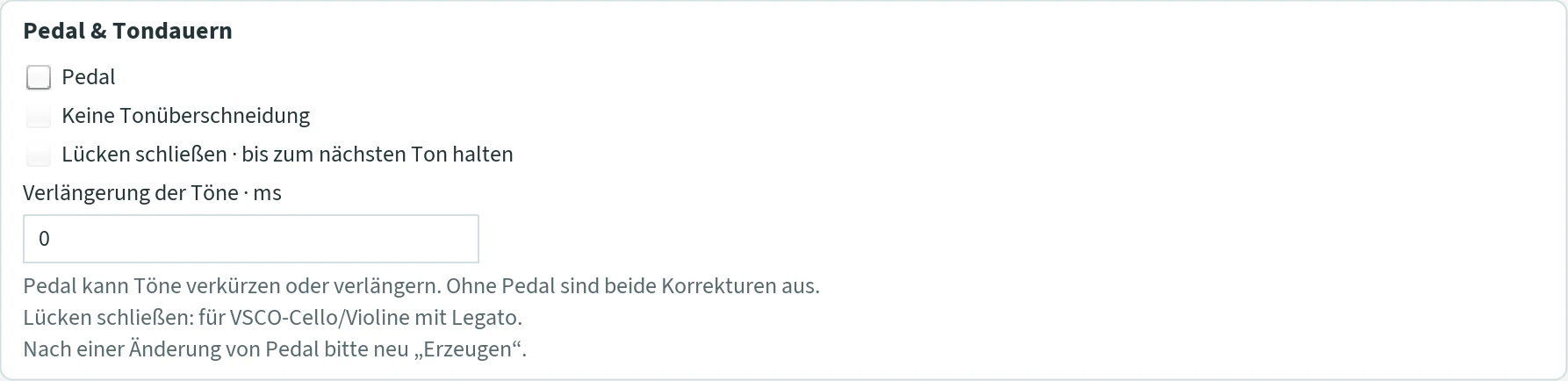
Pedal & Tondauern (pedal & note lengths)
How long the notes sound and whether they merge into each other.
- Pedal
- On: how long a note sounds is determined by the shadow sequence; when the next one begins stays the same. So some notes ring into the following ones, others end earlier, and rests arise – much like the piano pedal. Chord notes sound as long as their note. Off: the notes follow each other without gaps. Switching it off also switches off the two following ticks. Default off.
- Keine Tonüberschneidung (no overlapping notes)
- Only with “Pedal”. Ends every note at the latest when the next one begins; entries, pitches and chords stay. The own WAV sound gets soft transitions; with Csound, switch on “Legato” for this. Takes effect at the next listening, without generating again, and applies to all pieces.
- Lücken schließen · bis zum nächsten Ton halten (close gaps · hold until the next note)
- Only with “Pedal” and the VSCO strings with “Legato”: holds string sounds until the next entry, also across composed rests. See VSCO.
- Verlängerung der Töne · ms (note extension)
- Makes every note longer by this many milliseconds, in all voices; the entries stay. This gives reverberation and legato. With MIDI, the own WAV sound and SWAM/VSCO a change takes effect at the next listening, with Csound only after generating again. In Csound, identical notes that overlap become louder. 0 means: no extension. Default 0.
Reaktion am Gipfel & Tempo (reaction at the peak & tempo)
What happens when the main voice reaches a new peak – that is, arrives at the heaviest point of the weight distribution for the first time. The reaction begins with the next note. Because new peaks become rarer over time, there are more reactions at the beginning of a piece.

- Reaktion am Gipfel (reaction at the peak)
- Ohne Gipfelreaktion (no peak reaction): nothing extra happens at the peak (default).
- Tonfolge weiterführen (Kaskade) (continue the sequence – cascade): from the peak note, notes follow in equal semitone steps. The first sequence rises, the next falls, and so on. At the edge of the range the note stays put. With a tuning system, each note moves to the nearest note of the system.
- Motiv wiederholen (Schleife) (repeat the motif – loop): the last notes up to the peak note are repeated.
- Transposition: the pitch shifts by a random number of semitones; several peaks add up. A note that falls out of the range is dropped – a rest arises in its place.
- Einstellungen … (settings)
- Opens the window “Effekte · Gewichtungsgipfel” with all the numbers, see below. The menu item Optionen › Effekte … in the main window opens the same window.
- Laufender Tempoverlauf (running tempo curve)
- A tempo that swings slowly back and forth, independently of the peak: it starts at 60 MM, rises to the maximum, falls to the minimum and so on. It changes at random moments, roughly at every “Auswahlmenge”-th note. The tempo only changes when the notes begin, not how long they sound: faster than 60 MM the notes overlap, slower than that rests arise. Default off.
- Zusätzliche Melodiestimme (additional melody voice)
- A voice of its own high above the composition, between c'' and b'' (523 to 988 Hz), always in equal-tempered semitones. It begins with the first note and changes its note when the main voice reaches a new peak; each note sounds until shortly before the next. The new note fits the main voice: at the interval of a unison, minor or major third, fifth, minor or major sixth. Which interval and how loud is decided by a shadow sequence of its own. No chord notes. MIDI channel 8. Default off.
- Melodiestimme zeitlich versetzen (offset the melody voice in time)
- New notes of the melody voice enter a little later, by at most the longest duration. The previous note is extended so that no gap arises. Only with “Zusätzliche Melodiestimme”. Default off.
Window “Effekte · Gewichtungsgipfel” (effects · weight peak)
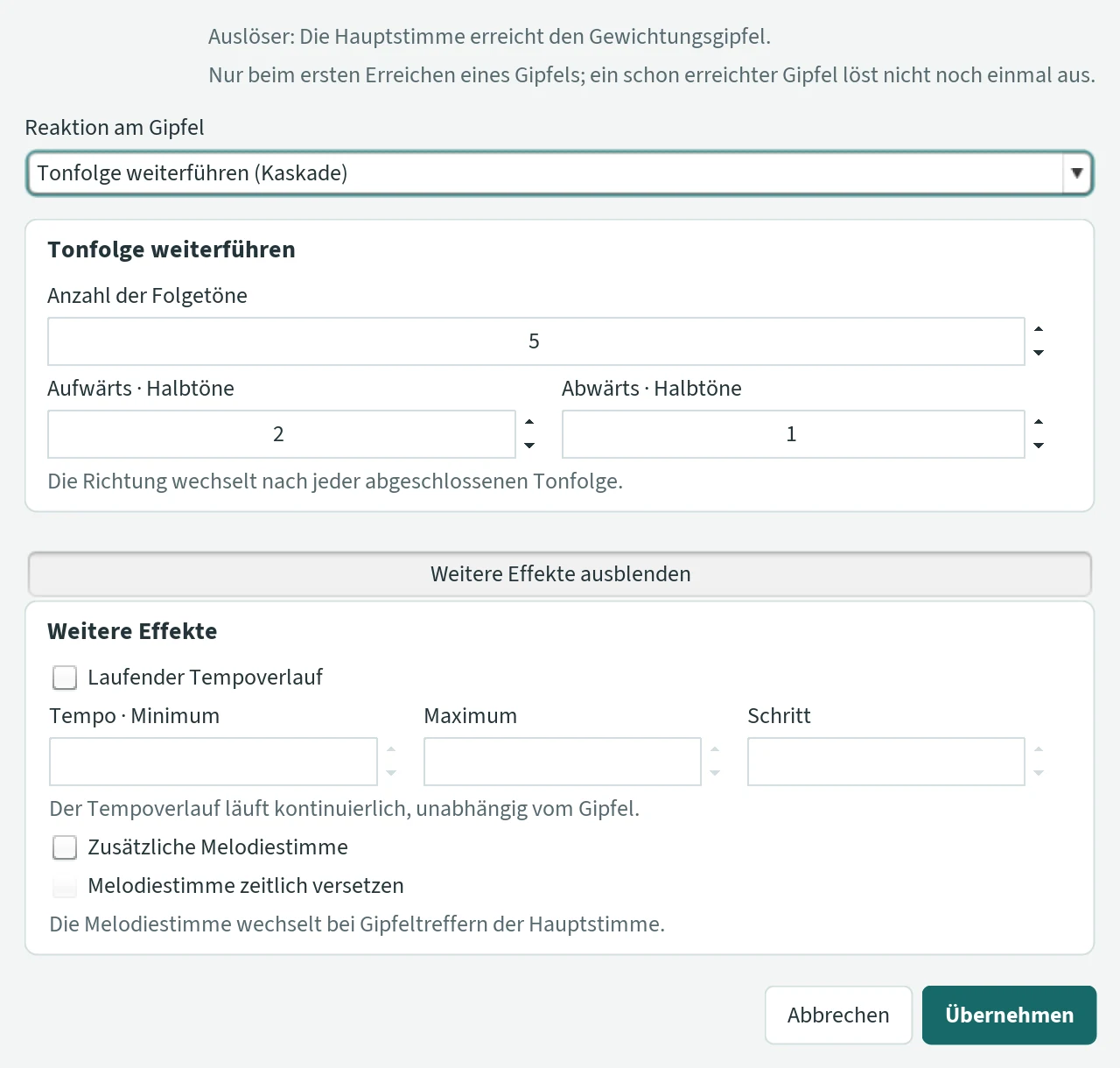
At the top you choose the reaction; below it only its fields appear. “Weitere Effekte anzeigen” (show further effects) shows tempo and melody voice. “Übernehmen” (apply) saves, “Abbrechen” (cancel) discards.
| Field | Meaning | Range | Default |
|---|---|---|---|
| Anzahl der Folgetöne | how many notes a cascade has | 1–10 000 | 5 |
| Aufwärts · Halbtöne | step size of the rising cascade, in semitones | 1–127 | 2 |
| Abwärts · Halbtöne | step size of the falling cascade, in semitones | 1–127 | 1 |
| Länge des Motivs · Töne | how many notes the loop repeats | 1–10 000 | 6 |
| Wiederholungen | how often (repetitions) | 1–10 000 | 1 |
| Rhythmus und Dynamik bei der Wiederholung variieren | vary rhythm and dynamics in the repetition. Off: the notes are copied exactly. On: only the pitches; duration and loudness arise anew. With “Ausdruck: Eigenentwicklung” they always arise anew. | tick | off |
| Untergrenze · Halbtöne | largest shift downwards, in semitones | −127–0 | −3 |
| Obergrenze · Halbtöne | largest shift upwards (0 is also possible) | 0–127 | 3 |
| Tempo · Minimum / Maximum | limits of the tempo curve in MM | 10–500 | 30 / 120 |
| Schritt | how much the tempo changes each time (step), in MM | 1–100 | 1 |
Tab “Klang”
Here you choose what you listen and save with. The choice takes effect at the next “Anhören”, without generating again: the notes stay the same, only the sound changes. So you can compare a piece with different sounds. All sound settings are saved immediately.
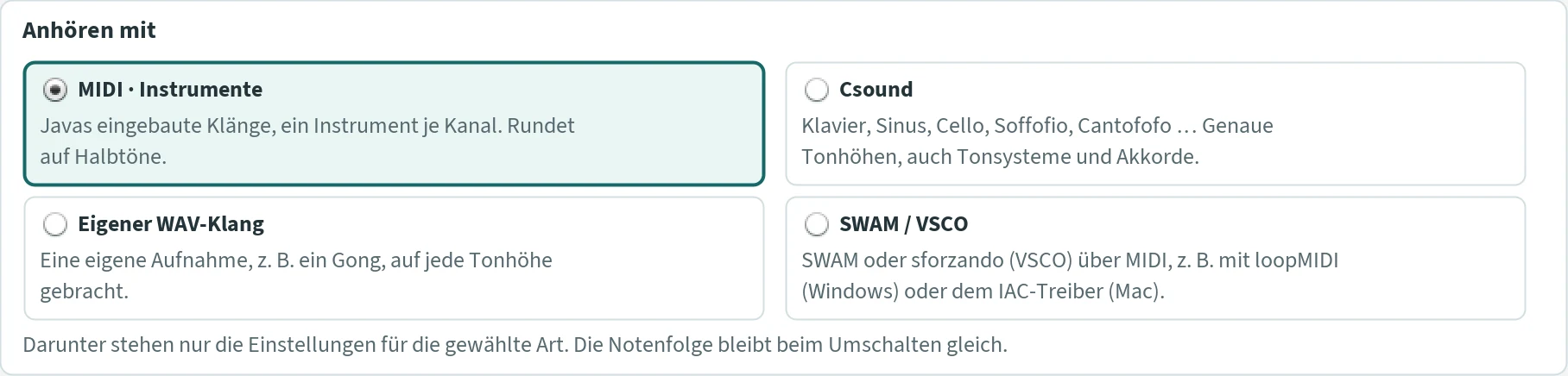
- MIDI · Instrumente (MIDI instruments)
- Java’s built-in sounds, one instrument per channel. Needs no other program, but rounds to semitones. Save button: “MIDI speichern”.
- Csound
- Sounds built specially for JCself, with exact pitches – also for tuning systems and justly tuned chords. Needs the free program Csound. Save button: “WAV speichern”.
- Eigener WAV-Klang (own WAV sound)
- A recording of your own, for example a gong, brought to every pitch. Save button: “WAV speichern”.
- SWAM / VSCO
- External instruments via MIDI. Save button: “MIDI speichern”.
Below the cards, only the settings of the chosen kind are shown.
MIDI · Instrumente
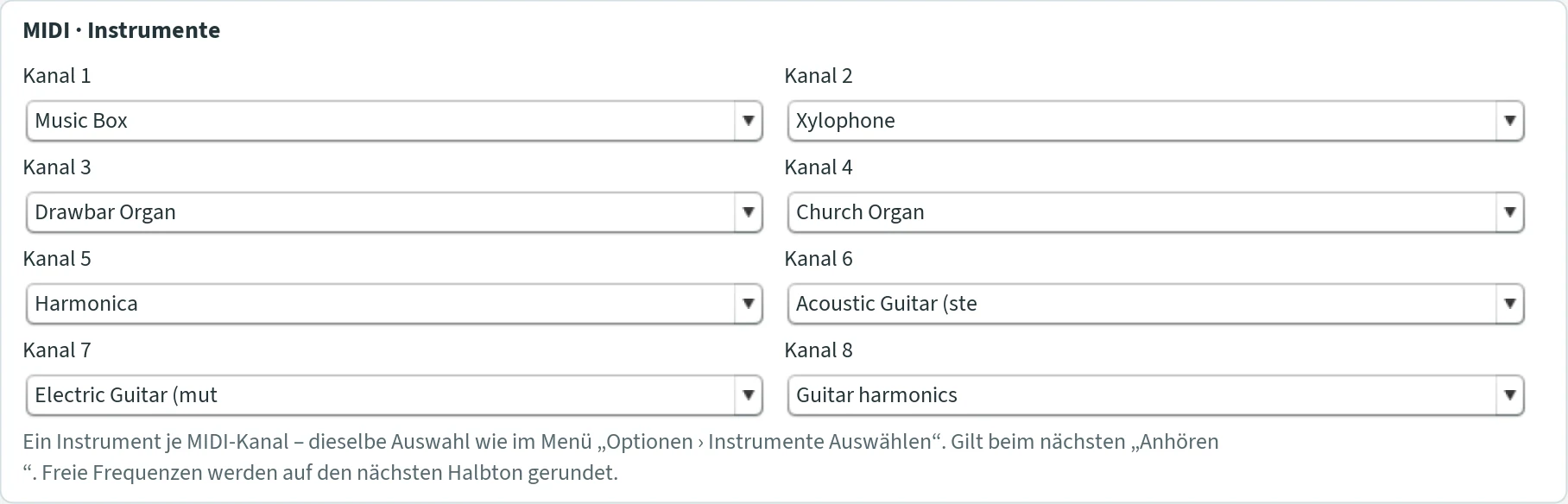
For each of the eight channels you choose an instrument, for example “Vibraphone” or “Cello” (the names come from Java and are in English). The choice takes effect at the next listening. Each channel plays certain voices:
| Channel | Content |
|---|---|
| 1 | main voice and all chord notes |
| 2 to 7 | further voices (“Stimmen · von / bis”) |
| 8 | additional melody voice |
- Every note is rounded to the nearest semitone. For exact pitches and other tuning systems, use Csound or the own WAV sound.
- Loudness and place in the stereo image are sent along.
- MIDI speichern (save MIDI) becomes available after you have listened to the piece with MIDI. Exactly this listening is saved – after “Abbruch”, only the part you heard. The file is placed next to the Csound file, with the same name and the extension
.mid; an older file of that name is replaced without asking. Each voice is on its own channel with its own instrument. - Optionen › Instrumente Auswählen leads here.
Csound
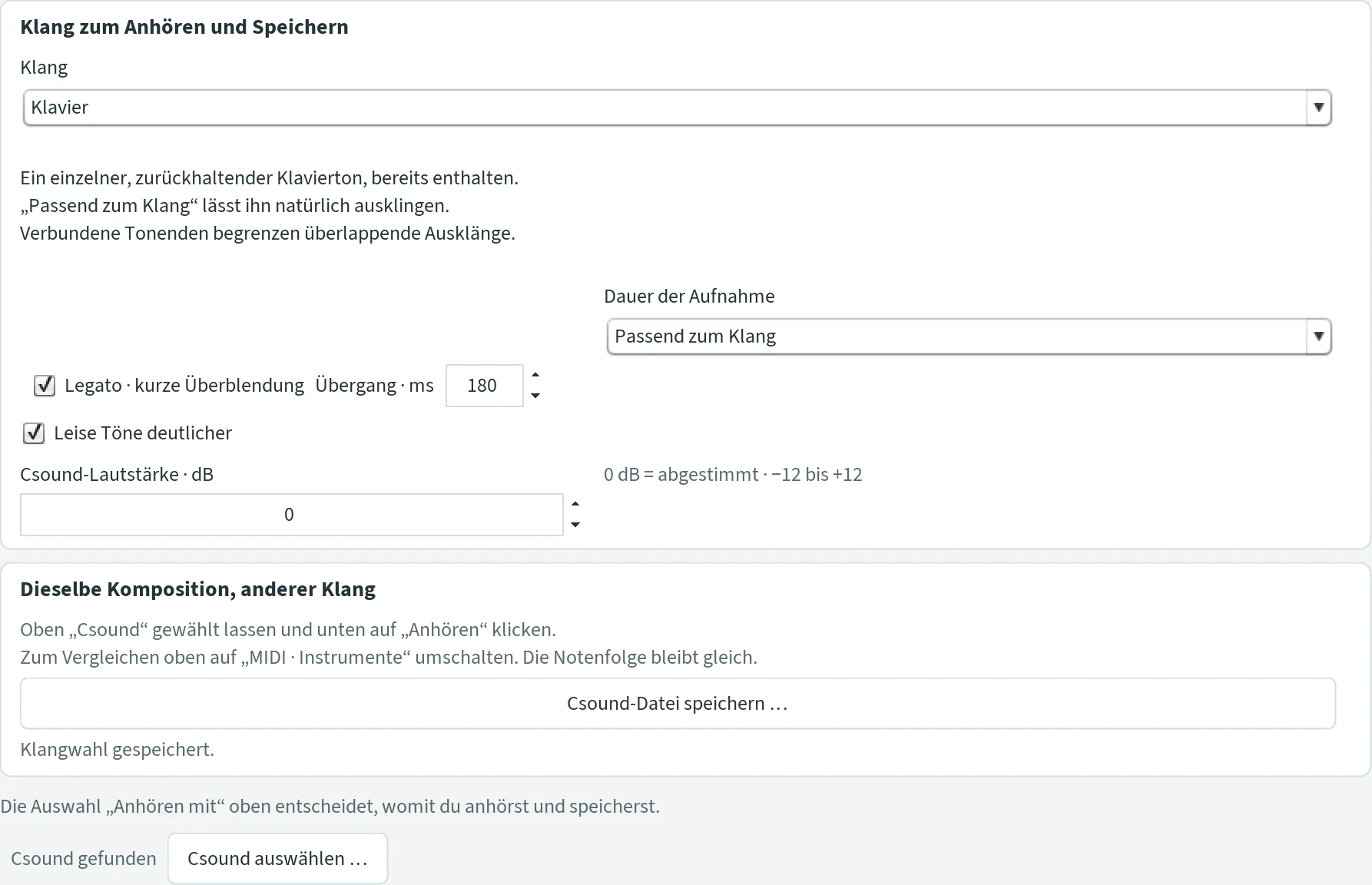
With Csound you hear every note exactly as JCself calculated it. Csound plays in the background through the computer’s usual sound output. If JCself does not find Csound, it asks for it the first time you listen.
Klang (sound)
| Sound | Character |
|---|---|
| Sinus – weich (sine – soft) | A pure sine tone with soft fade-in and fade-out. |
| FOF – Formantklang (formant sound) | Sounds made of many tiny sound grains, some of them voice-like, in eight variants, see below. |
| Lorenz – Schmetterlingsbahnen (butterfly orbits) | A continuous sound with moving metallic colours, a warm base and subtle reverberation. |
| Cello | A recorded cello note, brought to every pitch. |
| Trompete (trumpet) | A recorded trumpet note. |
| Klavier (piano) | A single, restrained piano note that rings out naturally. |
| JCself-Sinus | The original sound of JCself: a pure sine tone per note. If “Eigenen Klang verwenden” is switched on for the own WAV sound, Csound plays that recording here instead. |
Below the choice, a text describes the selected sound. Depending on the sound, further settings appear:
- Dauer der Aufnahme (length of the recording)
- Only cello, trumpet, piano. Passend zum Klang (to suit the sound): the piano rings out naturally, cello and trumpet are held. Gehalten · volle Notendauer (held · full note length): the note lasts exactly as long as the note value; long notes carry too. Originalaufnahme · eigener Ausklang (original recording · own decay): the note lasts as long as the recording (cello 4.4 s, trumpet 4.2 s, piano 10 s).
- Formantfarbe (formant colour)
- Only with the FOF variant Vocefof: Dunkel – O (dark), Offen – A (open), Hell – I (bright).
- Legato · kurze Überblendung (legato · short crossfade)
- Lets directly successive notes merge into each other briefly; how long is set by Übergang · ms (transition) (20 to 600, default 180). Rests remain rests. Not with “JCself-Sinus”; the FOF variants except Vocefof have their own transition. Default on.
- Leise Töne deutlicher (quiet notes clearer)
- Reduces the differences in loudness: quiet notes come forward, strong ones stay emphasised. Off: the full dynamics of the composition. Not with “JCself-Sinus”; has no effect with Soffofio. Default on.
- Csound-Lautstärke · dB (Csound volume)
- The overall volume of all Csound sounds, from −12 to +12 dB. At 0 dB the sounds are matched to each other and roughly equally loud. A soft limiter prevents clipping. Applies to listening, WAV and Csound file.
- Tiefe Töne gehörrichtig (low notes loudness-compensated)
- Only with “Sinus – weich” and “JCself-Sinus”. The ear hears low sine tones as quieter than middle ones, even when they are equally strong. On: notes below 400 Hz become suitably louder, about 200 Hz by 6 dB, 160 Hz by 9 dB, at most 12 dB. A piece becomes louder overall as a result; lower the Csound volume if necessary. Default on.
FOF variants
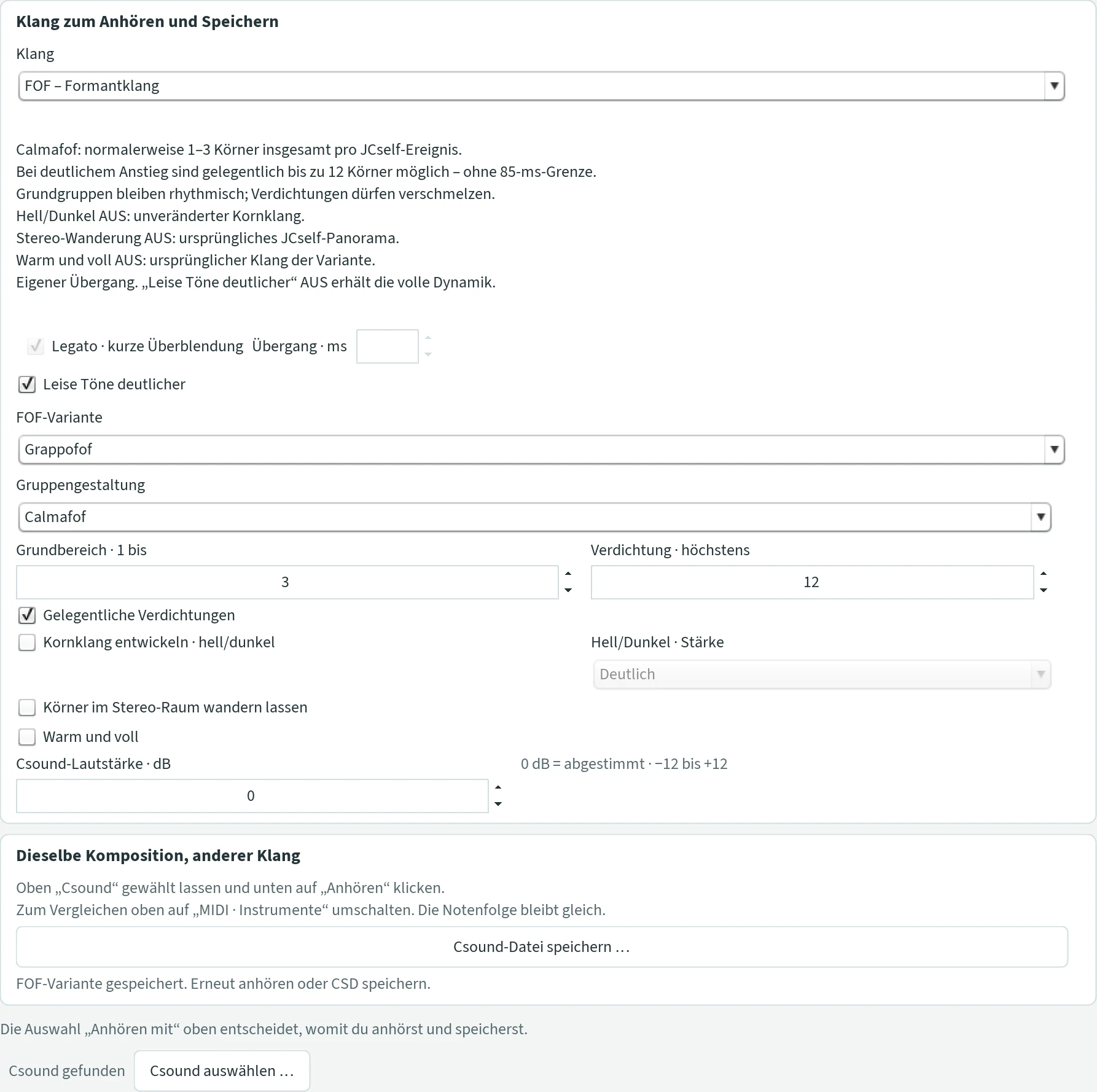
FOF sounds arise from many tiny sound grains. Depending on how dense and how shaped these grains are, it sounds like breath, singing, trickling, drops, bells or a gong. You choose the variant under FOF-Variante:
| Variant | Character |
|---|---|
| Soffofio | The breath: every note opens and settles again. Fixed fundamental 110 Hz; your pitch colours the sound. Round grains, warm reverberation. Default. |
| Granfofina | Trickling grains, 2 to 128 per second; how dense results from pitch and loudness. |
| Cantofofo | Overtone singing: fixed fundamental 110 Hz with small, human fluctuations, vowels A, E, I, O, U; your pitches steer the overtone melody. |
| Vocefof | A voice at your pitch; louder also sounds brighter. You choose the vowel under “Formantfarbe”. |
| Gocciafof | Single drops, 0.5 to 6 per second, without a continuous tone; the pitch colours the drops. |
| Grappofof | Grain clusters: for every note a small group of grains, see below. |
| Campanafof | Bell grains: every grain is a small bell stroke with a long decay; the grains ring into each other. The higher the note, the more metal. Density as with Granfofina: low notes sound like single strokes, high ones merge into a shimmer. |
| Bronzofof | Gong grains: every grain is a short excerpt from a gong recording, tuned to the pitch of the note. Each voice wanders slowly through the recording, so the colour changes continuously. Density as with Granfofina; you can exchange the recording, see below. |
With Soffofio and Cantofofo the fundamental stays at 110 Hz; your pitches colour the sound. Chords cannot be heard as chords there.
- Warm und voll (warm and full)
- For all variants except Soffofio, Campanafof and Bronzofof (these two sound warm and full by themselves), saved separately for each. On: a round, full sound at the pitch of the note, with overtones and long reverberation (with Vocefof a deeper, rounder vowel). Off: the variant’s original, slimmer sound. Rhythm, number of grains and dynamics stay the same. Default on for Granfofina, Cantofofo and Vocefof, off for Gocciafof and Grappofof.
- Gruppengestaltung (group design)
- Only Grappofof. Calmafof: calm, small groups of 1 to Grundbereich (basic range) grains (default 3). With Gelegentliche Verdichtungen (occasional condensations) the groups grow when pitch or loudness rise markedly – up to Verdichtung · höchstens (condensation · at most) grains (default 12). Sciamefof: often larger groups, a swarm; the limits then do not apply.
- Kornklang entwickeln · hell/dunkel (develop grain sound · bright/dark)
- Only Grappofof. Every grain becomes brighter or darker over time, depending on how the music continues. Hell/Dunkel · Stärke (strength): Dezent (subtle), Deutlich (clear, up to about one octave of movement per grain) or Stark (strong, up to two octaves). Default off.
- Körner im Stereo-Raum wandern lassen (let the grains wander in stereo space)
- Only Grappofof. The grains wander between left and right – slowly, attracted by neighbouring notes and steered back when they stay on one side too long; no even swinging. Best with headphones. Default off.
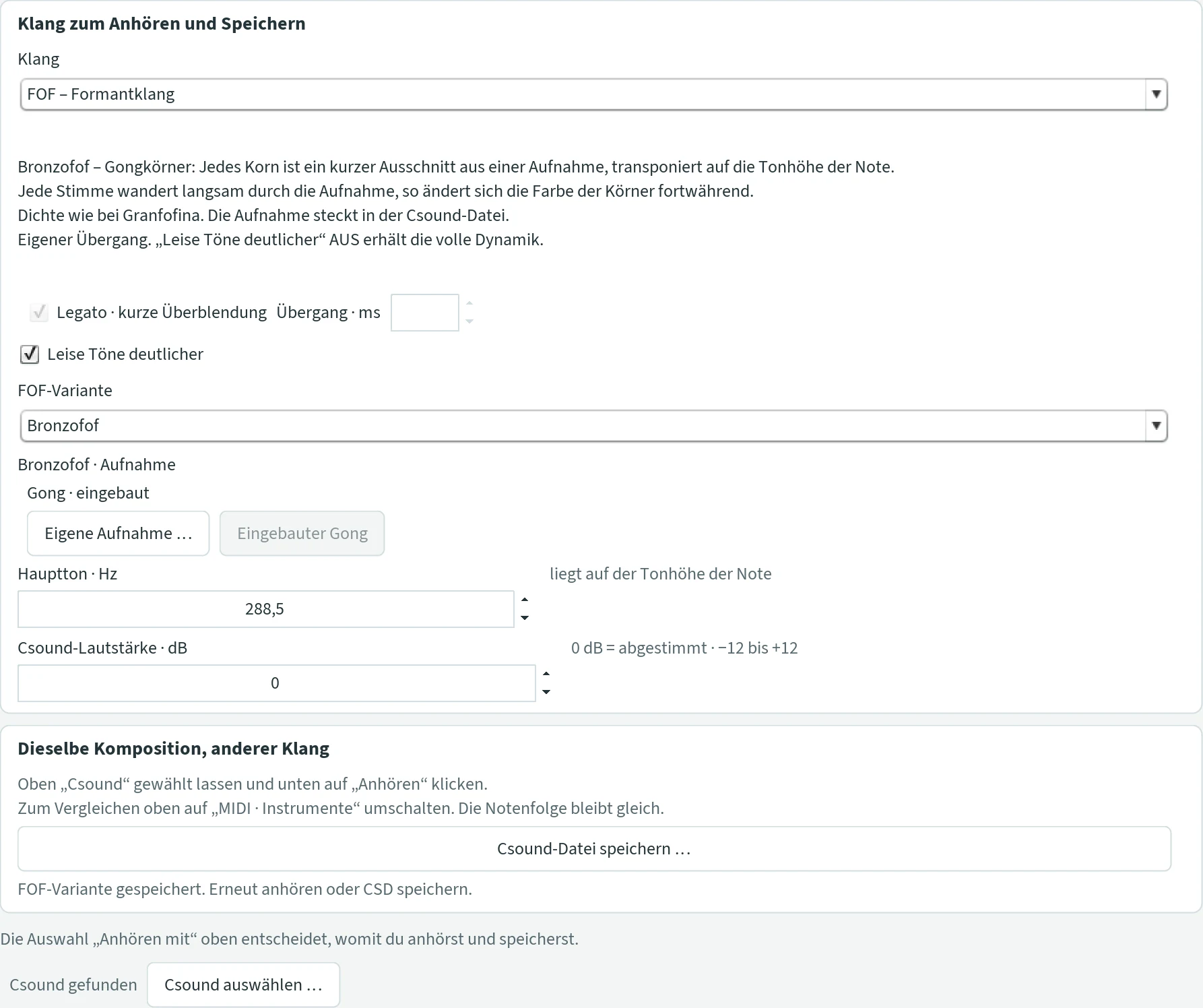
- Bronzofof · Aufnahme (recording)
- Only Bronzofof. A gong recorded by Peter Heeren is built in. With Eigene Aufnahme … (own recording) you choose a WAV or AIFF file, for example another gong, a singing bowl or a voice. JCself takes the first 22 seconds of the first channel, makes them as loud as the gong and stores them in the folder
Gipfel-DatenunderCsound-Klaenge; there the recording moves along when you copy the folder to another computer. Eingebauter Gong (built-in gong) leads back. If a chosen recording is missing later, the gong sounds again. - Hauptton · Hz (main tone)
- Only Bronzofof. The part of the sound that lies at the pitch of the note. For the built-in gong 288.5 Hz; for a recording of your own, JCself measures the strongest partial between 60 and 2000 Hz. You can change the value (20 to 4000 Hz): twice the value puts all grains an octave lower, half the value an octave higher.
Csound file, finding Csound
- The Csound file (.csd)
- “Erzeugen” writes every piece as a Csound file – with the sound currently set under “Csound”, even if you listen with something else. Everything is in this one file: the sounds, the notes and the recordings of cello, trumpet, piano, Bronzofof or your own sound. It can be opened and edited further in Csound or CsoundQt. A saved file does not change later.
- Csound-Datei speichern … (save Csound file)
- In the section “Dieselbe Komposition, anderer Klang” (same composition, different sound): saves the existing piece with the sound now set as a new Csound file, without composing again. The next “Erzeugen” and “MIDI speichern” then use this new name.
- Csound auswählen … (choose Csound)
- Next to it is “Csound gefunden” (Csound found) or “Csound noch nicht gefunden” (not found yet). Choose the file
csound.exein the subfolderbinof the Csound installation (Windows) or the filecsound(Mac) – not CsoundQt. - WAV speichern (save WAV)
- Csound renders the piece as a WAV file, stereo with 24 bit and 44.1 kHz (48 kHz with Soffofio, Granfofina, Cantofofo, Gocciafof, Grappofof, Campanafof and Bronzofof). You choose the location freely. A piece may last at most 120 minutes.
Eigener WAV-Klang (own WAV sound)
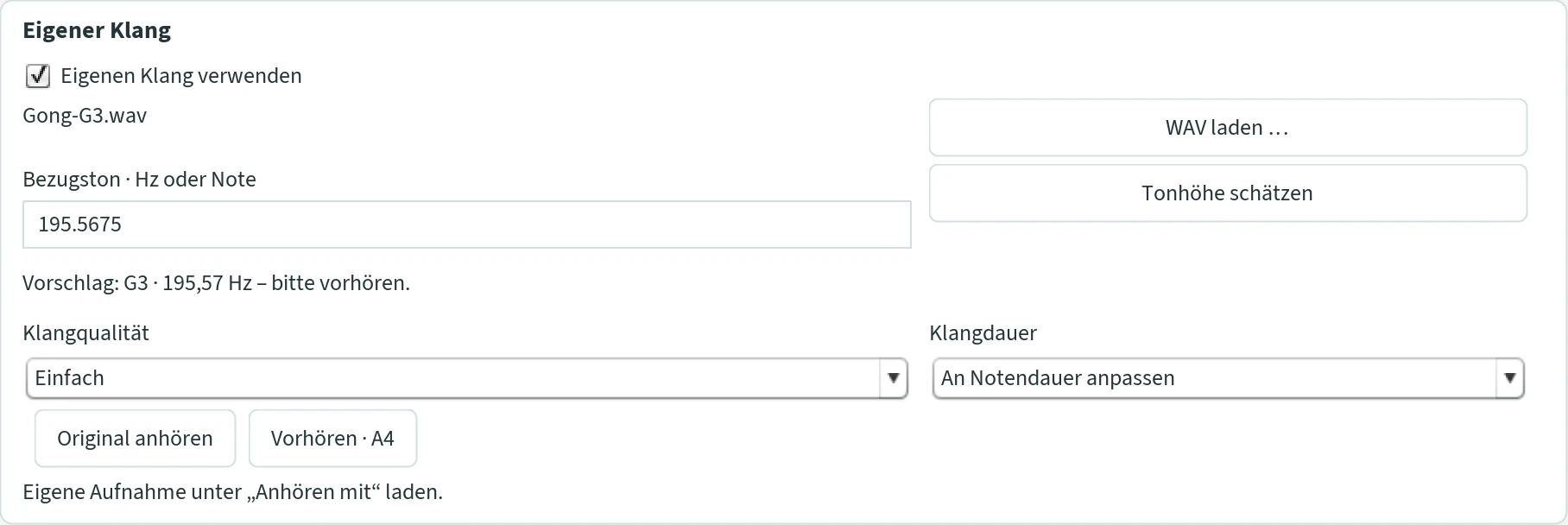
JCself plays your piece with a recording of your own, for example a gong, a singing bowl or a voice: the recording is tuned higher or lower to suit every note.
- WAV laden … (load WAV)
- Mono or stereo, 8 to 192 kHz, PCM or floating point, at most 120 seconds. JCself makes a working copy in the folder
Gipfel-Daten; the original remains untouched. Then it estimates the pitch. - Bezugston · Hz oder Note (reference pitch · Hz or note)
- Which pitch the recording has – as a number (440, also 261,63) or as a note in German names (A4, Cis4 for C♯4, Fis3 for F♯3; German H and B are distinguished: H = B natural, B = B♭; A4 = 440 Hz, C4 = 261.63 Hz). From this JCself calculates how far it retunes the recording for each note, exactly, without rounding. Confirm with Enter.
- Tonhöhe schätzen (estimate pitch)
- Estimates the reference pitch again. The result reads, for example, “Vorschlag: G3 · 195,57 Hz – bitte vorhören” (suggestion … please preview). For noises or bells with an unclear pitch, enter the reference pitch yourself.
- Eigenen Klang verwenden (use own sound)
- Switches the recording on. At the same time, Csound with the sound “JCself-Sinus” then plays this recording.
- Klangqualität (sound quality)
- Hoch · Rubber Band (high): more precise changes of pitch and time with the included program Rubber Band; the calculation takes longer. Windows only. Einfach (simple): a built-in method, faster; always on the Mac.
- Klangdauer (sound length)
- An Notendauer anpassen (fit to note length): every recording is stretched or squeezed to the length of the note. Natürlich ausklingen lassen (let it ring out naturally): every note lasts as long as the recording; decays overlap, the entries stay.
- Original anhören · Vorhören · A4 (play original · preview A4)
- “Original anhören” plays the recording unchanged. “Vorhören · A4” plays it brought to 440 Hz: if that sounds like an A, the reference pitch is right.
When listening, JCself first calculates the whole mix (“Klang berechnen: 12 von 80 Tönen” (calculating sound: 12 of 80 notes)) and then plays it. “WAV speichern” writes stereo, 44.1 kHz, 24 bit.
SWAM / VSCO
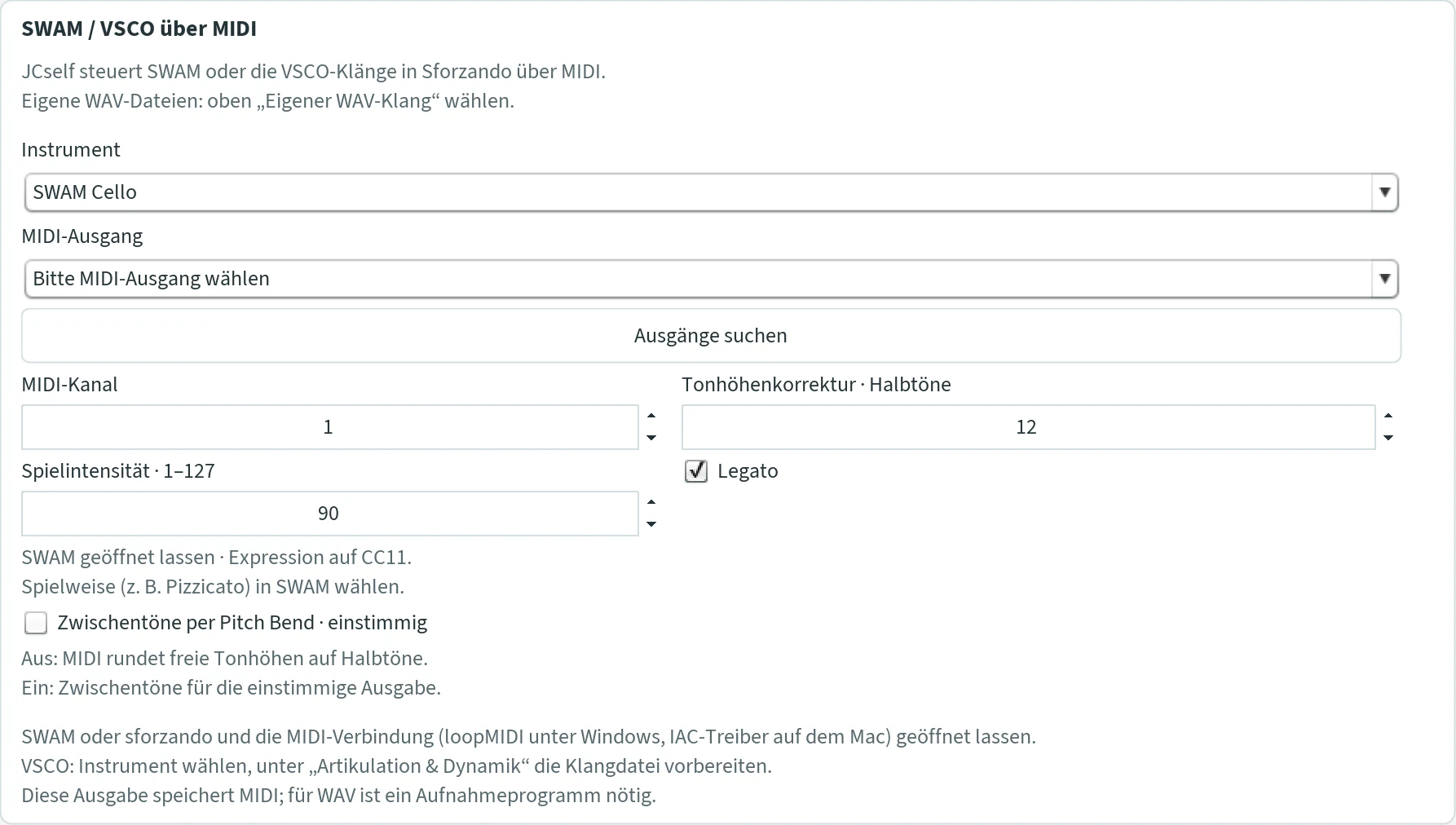
Here JCself does not produce any sound itself: it sends the composition via MIDI to another program – to instruments of the SWAM series by Audio Modeling, or to sforzando with the library VSCO 2 Community Edition. For this you need a virtual MIDI connection (loopMIDI on Windows, the IAC driver on the Mac) that is chosen as the input in the sound program. Keep both programs open.
- Instrument
- SWAM Cello, SWAM Violine (violin), Anderes MIDI-Instrument (other MIDI instrument), VSCO Cello-Ensemble, VSCO Solo-Violine, VSCO Trompete, VSCO Klavier. For VSCO see VSCO via sforzando.
- MIDI-Ausgang · Ausgänge suchen (MIDI output · find outputs)
- The virtual connection over which JCself sends. If a newly created connection does not appear, restart JCself.
- MIDI-Kanal (MIDI channel)
- 1 to 16. Default 1.
- Tonhöhenkorrektur · Halbtöne (pitch correction · semitones)
- Is added to every note. SWAM Cello is set to “Transpose −12” at the factory; then +12 here. If SWAM is set to 0, 0 here as well. With VSCO 0.
- Spielintensität · 1–127 (playing intensity)
- How strongly the instrument plays overall. JCself sends the loudness curve of the piece along by itself (as “Expression”, CC 11). 90 is a good starting point.
- Legato
- Connects successive notes; real rests remain. Default on.
- Zwischentöne per Pitch Bend · einstimmig (microtones via pitch bend · monophonic)
- Transmits the exact pitches instead of rounded semitones: before each note, JCself sends a fine correction. Set the pitch-bend range in the sound program to ±2 semitones. Only for monophonic sequences without chords; overlapping notes only with “Keine Tonüberschneidung”. Default off.
- SWAM Cello and SWAM Violine always play monophonically: switch off chords and further voices for them. Their range: cello C2–F6 (65.41–1396.91 Hz), violin G3–F7 (196–2793.83 Hz). You choose the playing technique, such as pizzicato, in SWAM.
- “Anderes MIDI-Instrument” may play polyphonically.
- MIDI speichern writes a MIDI file with all control data (suggested name
JCself-SWAM.mid). It can be played and recorded in a music program with SWAM or sforzando. JCself does not produce a WAV file in this mode; for that you need a recording program.
Listening and saving
The buttons at the bottom right
- Erzeugen (generate)
- Calculates a new composition and writes it as a Csound file. The first time, you choose location and name; after that JCself uses the same file and asks each time “Diese Datei ersetzen?” (replace this file?). With “Nein” (no) nothing is created. You choose a new name beforehand via Datei › Csound-Datei wählen … in the menu. At the end JCself reports “Csound-Datei gespeichert” (Csound file saved).
- Anhören (listen)
- Plays the most recently generated composition with the kind chosen in the tab “Klang”. Available as soon as something has been generated in this session: after the program starts, JCself does not load an earlier composition.
- MIDI speichern / WAV speichern (save MIDI / save WAV)
- The button follows the playback: “WAV speichern” with Csound and the own WAV sound, otherwise “MIDI speichern”. With MIDI it only becomes available after listening.
- Abbruch (cancel)
- Ends whatever is running. If you cancel “Erzeugen”, the previous composition is kept. Cancelled WAV files do not replace an existing file.
Generate again or just listen again?
| You change … | … and then |
|---|---|
| something in the tab “Komposition” | Erzeugen |
| “Keine Tonüberschneidung”, “Lücken schließen” | Anhören is enough |
| “Verlängerung der Töne · ms” | with Csound Erzeugen, otherwise Anhören |
| something in the tab “Klang” | Anhören is enough |
| something and want to update a saved file | save again – saved files do not change afterwards. For the Csound file: “Csound-Datei speichern …” or Erzeugen; for MIDI: listen first, then “MIDI speichern”. |
What is saved where
| File | Created by | Location |
|---|---|---|
| Piece.csd | Erzeugen, “Csound-Datei speichern …” | chosen freely |
| Piece.mid | “MIDI speichern” (MIDI) | next to the Csound file, same name |
| JCself-SWAM.mid | “MIDI speichern” (SWAM / VSCO) | chosen freely |
| JcSelf-Sound.wav | “WAV speichern” (Csound) | chosen freely |
| JcSelf-Eigener-Klang.wav | “WAV speichern” (own WAV sound) | chosen freely |
| Vorlage.jct | Datei › Template speichern | chosen freely |
| JCself-Duett.* / JCself-Trio.* | “Speichern …” in the duet/trio | chosen freely |
The first time, the file dialog opens in the folder Gipfel-Daten.
The display
At the top of the window, JCself shows the weight distribution from which it chooses. Before the first generation it reads “Die Gewichtsverteilung erscheint beim Erzeugen.” (the weight distribution appears when generating)
While composing
- Area
- The weight distribution over the range. The highest value always reaches the full height.
- Line with filled triangle
- The note just chosen.
- Ochre dot
- The peak, the point of the highest weight.
- Open triangle
- The start frequency.
- Labels
- Top left “Durchlauf …” (run), top right “Ton … Hz · Gipfel … Hz” (note … · peak …), at the bottom the hertz scale.
While listening

With Csound, the own WAV sound and SWAM/VSCO the display runs along: it shows the distribution that belonged to this moment of the composition, plus a strong line with a dot for each sounding note and thinner lines for the chord notes. Small arrows at the left or right edge stand for notes below or above the range shown. Top left reads “Wiedergabe 0:39 von 1:01” (playback 0:39 of 1:01), top right the sounding notes in hertz or “Pause” (rest). With MIDI the display shows the composition step by step (“Wiedergabe · Schritt …”). It does not run along while a WAV file is being saved. On slow computers it can run slightly ahead with Csound.
Anzeige 3D (3D display)

Under Optionen › Anzeige 3D, JCself staggers the distributions of the last runs one behind the other in perspective, the newest at the front. The red arrow shows the chosen note, the green one the start frequency; the axis is divided in kilohertz. The switch takes effect from the next “Erzeugen”; while listening, the usual view appears. Optionen › Anzeige 2D switches back.
Hintergrundbild (background picture)
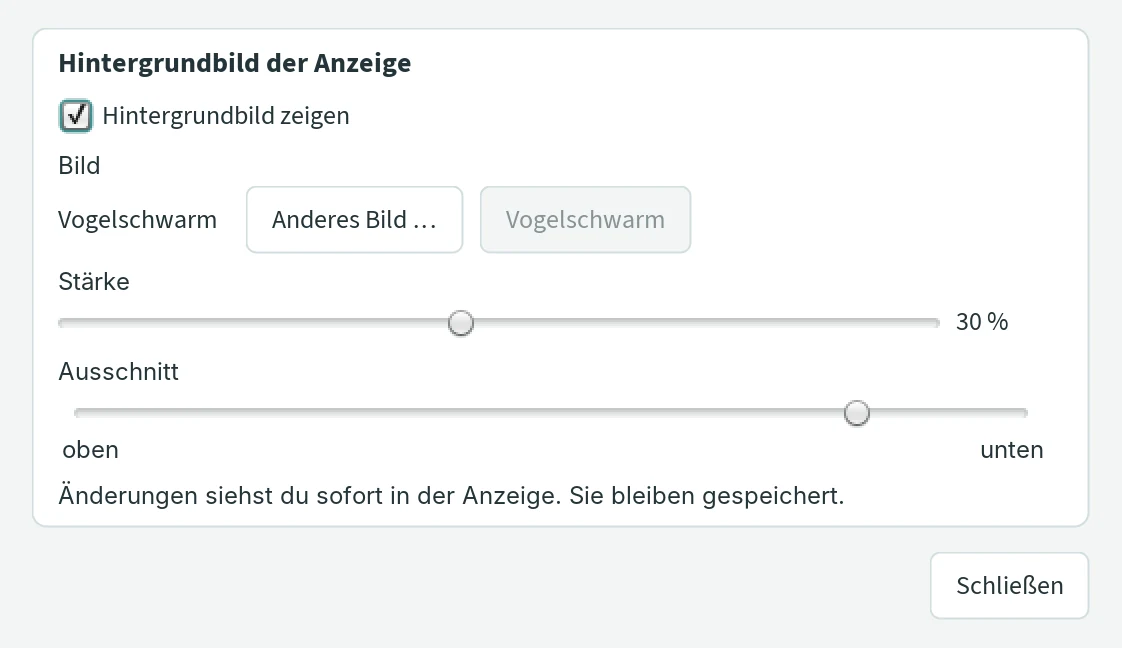
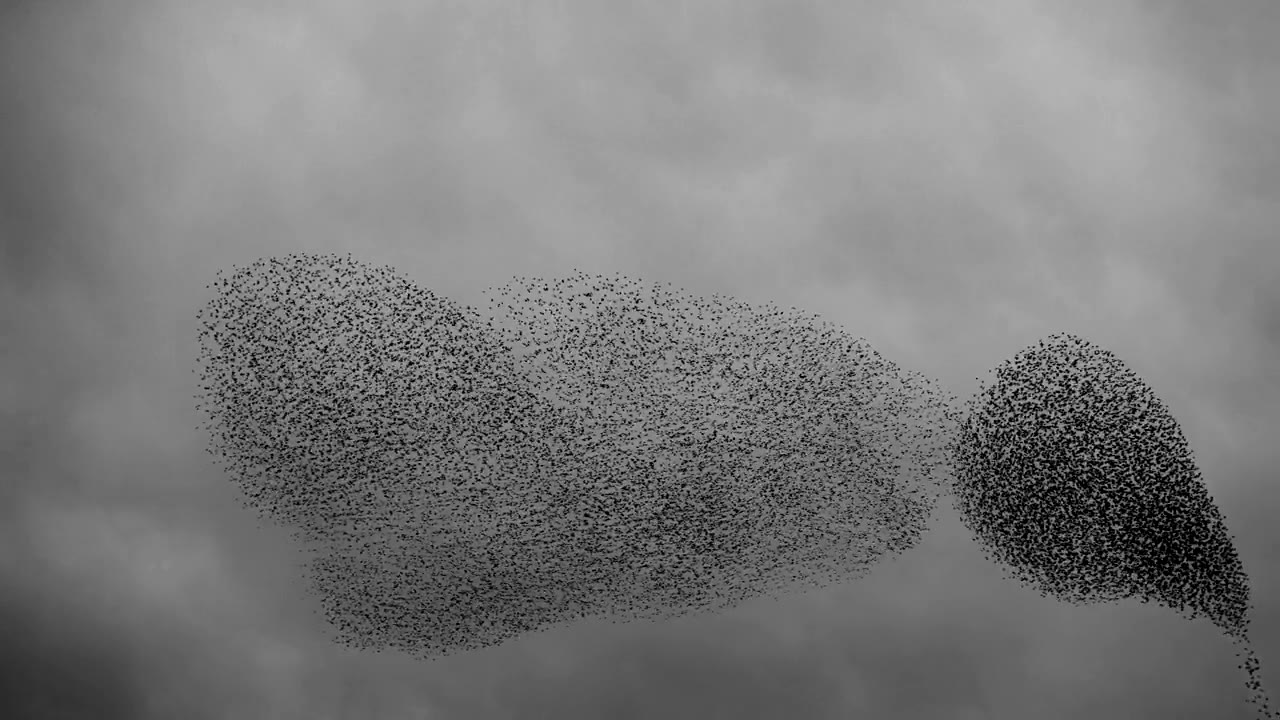
Behind the display lies a photo of a flock of birds. Under Optionen › Hintergrundbild … you switch it off (Hintergrundbild zeigen (show background picture)), choose a picture of your own (Anderes Bild … (other picture): JPG, PNG, GIF or BMP; the button Vogelschwarm (flock of birds) leads back), and set the Stärke (strength) (5 to 60 %, default 30 %) and the Ausschnitt (section, top to bottom). Every change is visible immediately and stays saved. JCself reads a picture of your own from its location; if you move it, the flock of birds appears again.
Duet and trio
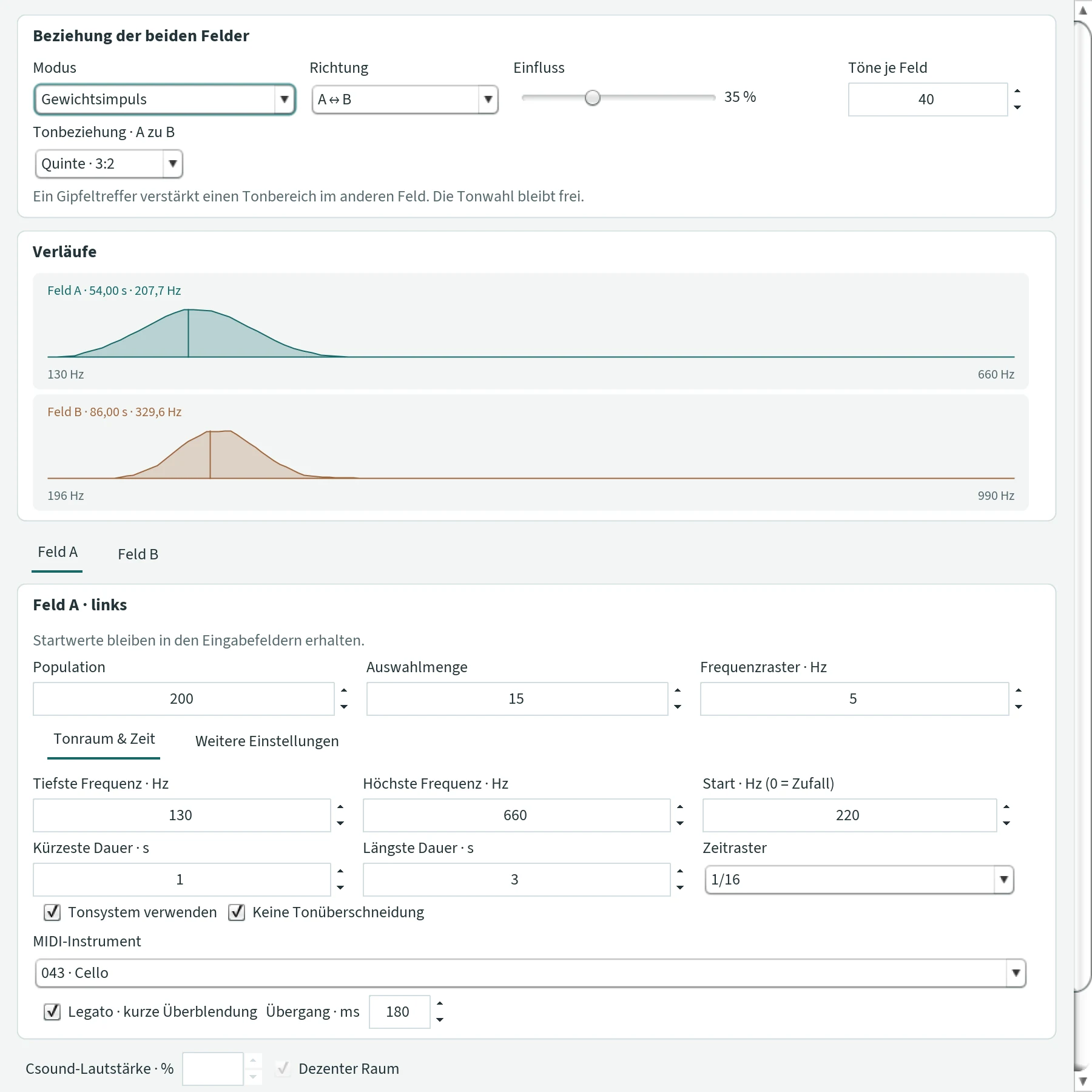
In the duet and the trio, two or three JCselfs compose at the same time, each with its own settings – like musicians listening to each other. The individual voices are called Felder (fields) (A, B and, in the trio, C). When a field reaches a new peak, it gives the others an impulse. So they stimulate each other without prescribing each other’s notes.
The buttons Duett … and Trio … open a window of their own for this; while it is open, the main window is locked. The duet is independent of the piece in the main window. The tuning system and the switches “Melodie” and “Ausdruck” apply here too, however.
Beziehung der Felder (relation of the fields)
- Modus (mode)
- How the impulse acts. Gewichtsimpuls (weight impulse): a peak in one field makes a certain region of notes more likely in the other field; which notes come there remains free. Evolution · Annäherung (evolution · convergence): at every peak the other field moves a little closer – in durations, population, selection size, grid, weighting width, chance, degression, entry spacing and extension, and also in the shape of its weight distribution. So the fields become more alike over time.
- Richtung (direction)
- Who stimulates whom. Duet: Unabhängig (independent – nobody), A → B (only A stimulates B) or A ↔ B (both each other). Trio: all each other.
- Einfluss (influence)
- How strongly the weight impulse acts, 0 to 100 %. Default 35 %.
- Tonbeziehung (pitch relation)
- At which pitch the impulse arrives in the other field: the same note (1:1), a fifth (3:2) or an octave (2:1). Example fifth: a peak at 220 Hz in field A makes the area around 330 Hz more likely in field B; in the trio, field C lies a fifth below A (147 Hz). Default fifth.
- Annäherung pro Gipfel · % (convergence per peak)
- Only with evolution: how far the other field moves closer at each peak, 0 to 95 %. Default 20 %. Tonräume mit angleichen (align ranges as well) also brings the lowest and highest frequency closer.
- Töne je Feld (notes per field)
- The runs per field, 1 to 1000. Default 40.
Verläufe (curves) and fields
Under “Verläufe”, a small display for each field shows its weight distribution and the chosen note, running along while generating and listening. A thick line means: here the field reaches a peak. “Impuls: … Hz” means: here an impulse from another field arrived.
The tabs Feld A, Feld B and, in the trio, Feld C contain the settings of each field, as in the main window: population, selection size, frequency grid, range, start, durations, time grid, “Tonsystem verwenden”, “Keine Tonüberschneidung” and, under “Weitere Einstellungen” (further settings), weighting width, random weighting, degression, legato and two fields of their own:
- Einsatzabstand · % (entry spacing)
- Distance to the next entry as a percentage of the note length. 100 %: the next note begins when the previous one ends. Less: the notes overlap. More: rests arise.
- Tonverlängerung · s (note extension)
- Lets every note sound longer, in seconds.
Each field plays monophonically, with dynamics between mp and f, without chord, pedal and peak reactions. In space, field A stands on the left, B on the right, C in the centre. Depending on “Anhören mit”, you choose for each field a MIDI instrument, a Csound sound (with FOF variant) or an external MIDI output; external voices need different ports or channels.
At the bottom of the window
- Anhören mit (listen with)
- MIDI, Csound or SWAM / external MIDI – independent of the main window.
- Csound-Lautstärke · % · Dezenter Raum (Csound volume · subtle room)
- Only with Csound: overall volume of the ensemble (0 to 200 %, default 100 %) and a small, warm reverberation for all voices.
- Duett erzeugen / Trio erzeugen (generate duet / trio)
- Calculates all fields; afterwards JCself reports something like “Duett bereit: 40 + 40 Töne, 2 Gipfelimpulse, 2 wirksam.” (duet ready: 40 + 40 notes, 2 peak impulses, 2 effective)
- Gemeinsam anhören · Stopp (listen together · stop)
- Plays all fields together; “Stopp” stops.
- Speichern … (save)
- “MIDI speichern …” (one track per field), “Csound-Datei …” (one common file), “WAV speichern …” (with Csound).
Sound settings such as legato, sound length, FOF variant, volume and room apply immediately to the existing result. Everything else, including the Csound sound and the MIDI instrument, requires generating again. The result is kept only while the window is open: save what you want to keep before you close it. The settings are kept, separately for duet and trio.
Menus and templates
Menu “Datei” (file)
- Csound-Datei wählen … (choose Csound file)
- Sets the name and location under which the next “Erzeugen” writes the Csound file (and “MIDI speichern” the MIDI file). Nothing is written yet.
- Template laden (load template)
- Loads a template (
.jct). If you have changed something since the start, JCself first asks whether you want to save the current settings as a template. - Template speichern (save template)
- Saves the current settings as a template. Suggested name “Vorlage.jct”; JCself adds the extension
.jct. - Beenden (quit)
- Asks for confirmation (“Yes” / “No”) and saves the settings. The same goes for the window’s close button and, on the Mac, ⌘Q.
Menu “Optionen” (options)
- Anzeige 2D · Anzeige 3D
- How the display is drawn, see 3D display.
- Hintergrundbild … (background picture)
- See background picture.
- Instrumente Auswählen (choose instruments)
- Selects “Anhören mit: MIDI · Instrumente” and opens the tab “Klang”.
- Effekte … (effects)
- The window “Effekte · Gewichtungsgipfel”, like “Einstellungen …” in the tab “Komposition”.
- Sprachen (languages)
- German or English, effective after a restart. Only older parts of the program are translated; most labels stay German. We recommend German – this manual uses the German labels.
- Über (about)
- Version and authors of JCself.
There are no keyboard shortcuts; while JCself is working, the menus are locked.
Templates
A template (Vorlage) records the settings of the tab “Komposition”, plus the MIDI instruments, the choice 2D/3D and the language. Not stored in the template are the tuning system, chord spacing, “Keine Tonüberschneidung”, “Melodie” and “Ausdruck”, and everything from the tab “Klang”, from duet and trio and the background picture; these settings apply to all pieces and stay as they are when a template is loaded. Templates are text files and can be passed on. Older templates can still be loaded.
Settings and files
All settings are in the folder Gipfel-Daten. JCself saves most of them immediately when you change them. The basic settings of the tab “Komposition” (file jcself.sav) are saved when you quit – provided you have changed something since the start or since last loading or saving a template. If you load a template and change nothing afterwards, the next start therefore begins with the previous settings.
The folder also holds logs of the last run (jcself.log, komposition.log), working copies of your own recordings (Klaenge) and the included instrument recordings (Csound-Klaenge). JCself deletes temporary files after use.
To continue working on another computer, copy the folder Gipfel-Daten along. Choose these again there: the Csound program, an own WAV recording, an own background picture, MIDI outputs and the VSCO folder.
VSCO via sforzando
This section is for advanced users. VSCO 2 Community Edition is a free collection of orchestral recordings; the free player sforzando plays them. JCself controls it via MIDI and chooses the playing technique – bowed, pizzicato, tremolo, mute – for each note by itself.
Setting up
- Install sforzando and download VSCO 2 Community Edition in the SFZ version 1.1.0. Unzip it in a fixed place. This creates the folder
VSCO-2-CE-1.1.0, the VSCO main folder (VSCO-Hauptordner). You do not put anything into this folder yourself. - Create a virtual MIDI connection (loopMIDI or the IAC driver) and choose it in sforzando as the MIDI input.
- In JCself, under “Klang”, choose the card “SWAM / VSCO”, as instrument for example “VSCO Cello-Ensemble”, the MIDI output and the pitch correction 0.
- Open “Artikulation & Dynamik …” (articulation & dynamics) and, with “Ordner wählen …” (choose folder), choose the folder
VSCO-2-CE-1.1.0. JCself remembers the folder; this is needed only once. - Leave the sound character on “Nach Anschlag” (by attack) and click “Klangdatei vorbereiten” (prepare sound file). JCself now writes a new file into the VSCO main folder by itself, without asking: for the cello ensemble
JCself-Cello-Art.sfz, for the other instrumentsJCself-Violine-Art.sfz,JCself-Trompete-Art.sfzandJCself-Klavier-Art.sfz. It combines the recordings of the individual playing techniques; the original VSCO files remain unchanged. First the window shows “Aufnahmen werden geprüft und Pegel angeglichen …” (checking recordings and matching levels), then, for example, “Bereit: JCself-Cello-Art.sfz – Diese Datei jetzt aus dem VSCO-Ordner auf Sforzando ziehen.” (ready … now drag this file from the VSCO folder onto sforzando). If no folder has been chosen yet, JCself reports “Bitte zuerst den VSCO-Hauptordner wählen.” (please choose the VSCO main folder first) - Drag this file from the folder
VSCO-2-CE-1.1.0onto the sforzando window. This is the only step done by hand: you do not need to copy or move anything. - Close the window “Artikulation & Dynamik” with OK and click “Anhören”.
The prepared file stays in the VSCO main folder. For another instrument, click “Klangdatei vorbereiten” once while that instrument is selected, and drag the new file onto sforzando.
Do NOT prepare a timbre SFZ (Klangfarben-SFZ) or load one into sforzando. Leave the sound character on “Nach Anschlag”. The other sound characters and the switches that depend on them (“Gehaltene Töne aus dem Dynamikverlauf entwickeln”, “Bogenphrasen aus dem Verlauf entwickeln”) need such a file and are therefore not described here.
Window “Artikulation & Dynamik”
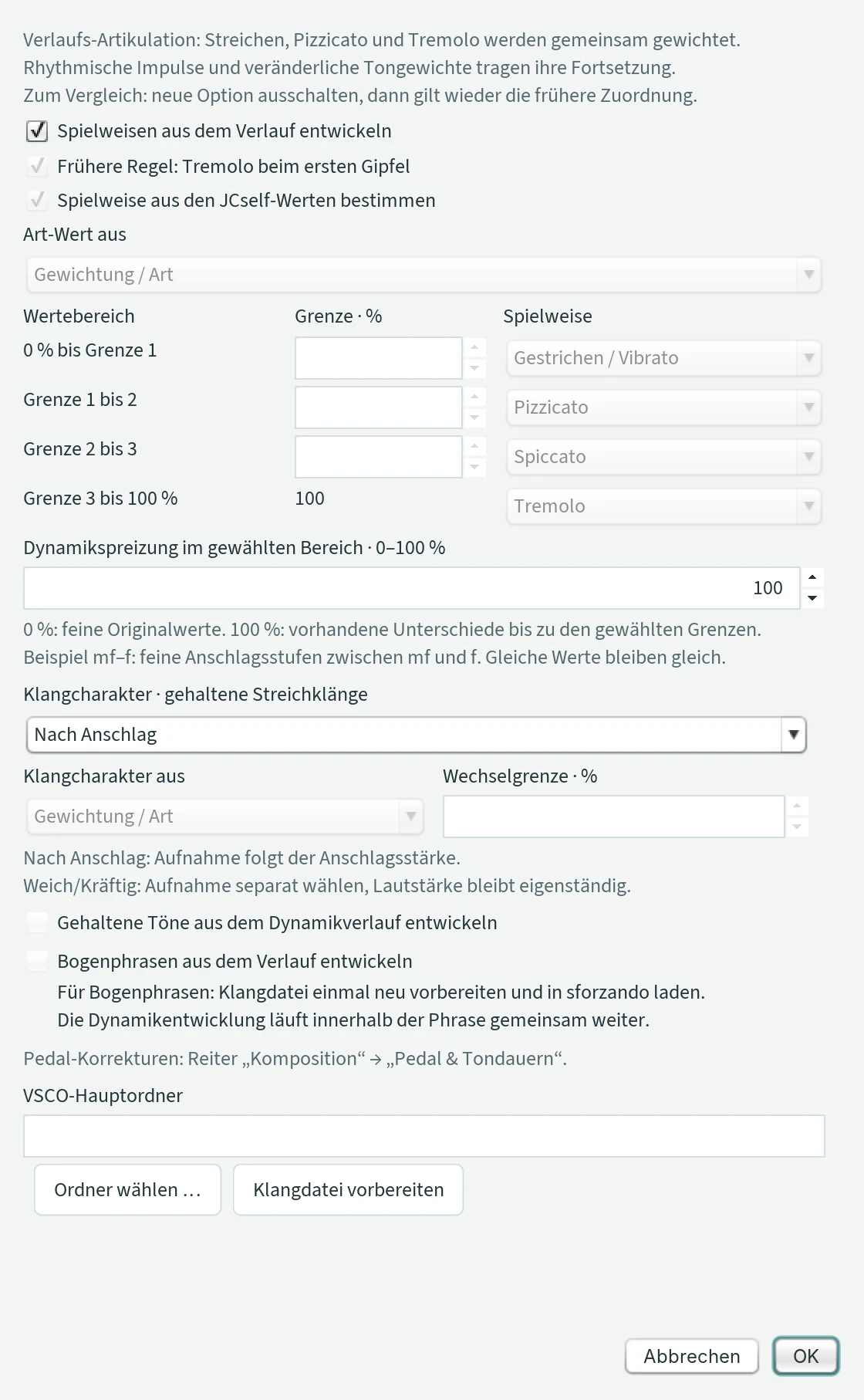
- Spielweisen aus dem Verlauf entwickeln (develop playing techniques from the course)
- Cello and violin only. For every note JCself chooses between bowed, pizzicato and tremolo, guided by the regularity of the rhythm, the note length and the movement; chords and new beginnings after rests are bowed. Default on.
- Frühere Regel: Tremolo beim ersten Gipfel (earlier rule: tremolo at the first peak)
- Applies when the previous tick is off: a new peak is played tremolo, everything else bowed.
- Spielweise aus den JCself-Werten bestimmen (determine playing technique from the JCself values)
- Applies when both previous ticks are off, and for the trumpet. A value – under Art-Wert aus (technique value from): weighting, loudness, pitch or stereo position – is stretched to 0 to 100 % over the whole piece; the table assigns one playing technique to each of four ranges (limits 25, 50, 75 %). Without this tick, the first row always applies. The piano has only one playing technique.
- Dynamikspreizung · 0–100 % (dynamic spread)
- 0 %: the fine original values. 100 %: the existing differences are spread up to the limits of “Lautstärke · von / bis”.
- VSCO-Hauptordner · Ordner wählen … · Klangdatei vorbereiten
- See above.
The VSCO recordings cover only certain ranges; limit the range in JCself accordingly: cello ensemble C2–F5, solo violin G3–C7, trumpet E3–C6 (with mute from B♭3), piano A0–C8 (C4 = middle C). With pedal and legato, “Lücken schließen” holds string sounds until the next entry. “MIDI speichern” also works without a prepared file.
Questions and solutions
- A value is not accepted.
- Write decimals with a point (0.5), whole numbers without point or comma. Press Enter or leave the field. If the value is outside the permitted range, the old one stays.
- “Anhören” is grey.
- “Erzeugen” first; after the program starts there is no composition yet. While JCself is working, only “Abbruch” is available.
- “MIDI speichern” is grey.
- With MIDI, listen first. After generating again or changing “Pedal” and “Keine Tonüberschneidung”, listen again.
- “Erzeugen” asks “Diese Datei ersetzen?”
- JCself writes every new piece into the same Csound file. “Ja” (yes) replaces it; for a new name, use “Csound-Datei wählen …” in the menu “Datei” beforehand.
- Message “Zeitraster und Tondauer”.
- No value of the time grid lies between the shortest and longest duration. Choose a finer grid, a larger duration range or “free”.
- Csound is not found.
- Install Csound and, under “Klang › Csound”, choose with “Csound auswählen …” the file
csound.exe(in the subfolderbin) orcsound– not CsoundQt. - Nothing can be heard with MIDI.
- Check the computer’s volume. If JCself reports that the MIDI device cannot be opened, another program may be using the sound output; close it and restart JCself.
- A tuning system does not sound as it should.
- MIDI rounds to semitones. Listen with Csound or the own WAV sound.
- Chords cannot be heard.
- Switch on “Akkord · synergetisch” and generate again. From four voices on, no chord notes are added. With Soffofio and Cantofofo the fundamental stays fixed; chords cannot be heard as chords there.
- The piece is too loud or too quiet.
- With Csound, adjust the “Csound-Lautstärke · dB”; “Tiefe Töne gehörrichtig” makes sine sounds louder. “Leise Töne deutlicher” reduces the differences.
- The own sound is out of tune.
- Check the reference pitch: “Vorhören · A4” must sound like an A. Otherwise enter the reference pitch by hand.
- The Mac does not start JCself.
- See Installation on the Mac: is Java installed? Allow the start file with right-click › “Open” or via “Privacy & Security”, or start in Terminal.
- Where does the file JCself-Cello-Art.sfz come from?
- JCself writes it into the VSCO main folder (
VSCO-2-CE-1.1.0) by itself as soon as you click “Klangdatei vorbereiten” under “Artikulation & Dynamik …”. The only thing you do by hand is drag it onto sforzando, see VSCO via sforzando. - Where are my settings?
- In the folder
Gipfel-Datennext to the program, see working folder.
JCself · Idea: Peter Heeren · Concept: Peter Heeren and Nils Kay · Programming: Nils Kay